# Suya OCR API
A FastAPI service that wraps the [Surya-OCR-2](https://huggingface.co/datalab-to/surya-ocr-2)
document-OCR model and serves it through **vLLM** for production-grade throughput and latency.
A single 650M vision-language model (`qwen3_5` architecture) performs both **layout detection**
and **text recognition** — there is no separate torch detection model in the hot path.
```
HTTP client ──► FastAPI app (surya/endpoint/, served via api.py shim :5002)
├─ legacy.py /v1/api/ai/* envelope endpoints
├─ openai.py /v1/chat/completions (OpenAI-compatible)
├─ request batcher (vllm_batcher.py) ← coalesces concurrent requests
│ ▼
└─ vLLM OpenAI server (:8000) ← Surya-OCR-2 VLM
```
> **Inbound OpenAI:** clients call `/v1/chat/completions`. **Outbound OpenAI:** the service itself calls the vLLM server via `surya/inference/backends/openai_client.py`.
---
## What was improved
This service started as a torch-spawn pipeline and was re-engineered for serving, with the
measured results summarized below:
| Area | Change | Result |
| --- | --- | --- |
| **Serving engine** | Recognition + layout now run through a vLLM **OpenAI-compatible** server instead of in-process torch | Continuous batching, CUDA graphs, prefix caching |
| **vLLM tuning** | CUDA graph on, prefix caching on, chunked prefill on (pinned in the launch script) | CUDA graph is the biggest lever — **~9.5× vs eager**; prefix cache ~15% |
| **Concurrency fix** | Matched the batcher's HTTP fan-out (`SURYA_INFERENCE_MAX_INFLIGHT`) to vLLM's 16 sequence slots | Closed a **33% mean / 32% p95** regression |
| **Request batching** | Added a coalescing batcher so concurrent page requests share vLLM batches | Fills all 16 slots under load |
| **Quantization study** | Benchmarked fp8/int8/awq/gptq/bnb4/bnb8 vs BF16 on A100 | **No method beats BF16 on latency**; int8 (GPTQ W8A8) near-lossless at ~40% smaller |
| **MTP speculative decode** | Tested `--speculative-config mtp` | **Rejected: +27–36% slower** at 16-wide block concurrency |
**Bottom line:** on A100 the latency levers are *serving config + batching*, not weight
quantization or speculative decoding. Keep BF16 with CUDA graphs and prefix caching on.
---
## Examples — multilingual OCR
Real outputs from **this service** (block mode, single A100) on public-domain newspaper/magazine
scans: the original page, the same page with detected text-block boxes (coloured by block type /
reading order; orange = non-text region skipped), and an excerpt of the recognised text. Full
text for each sample lives in [`assets/`](assets/).
| Language | Original | Detected boxes | OCR text (excerpt) |
| --- | --- | --- | --- |
| **Chinese**
叻報, 1890 | 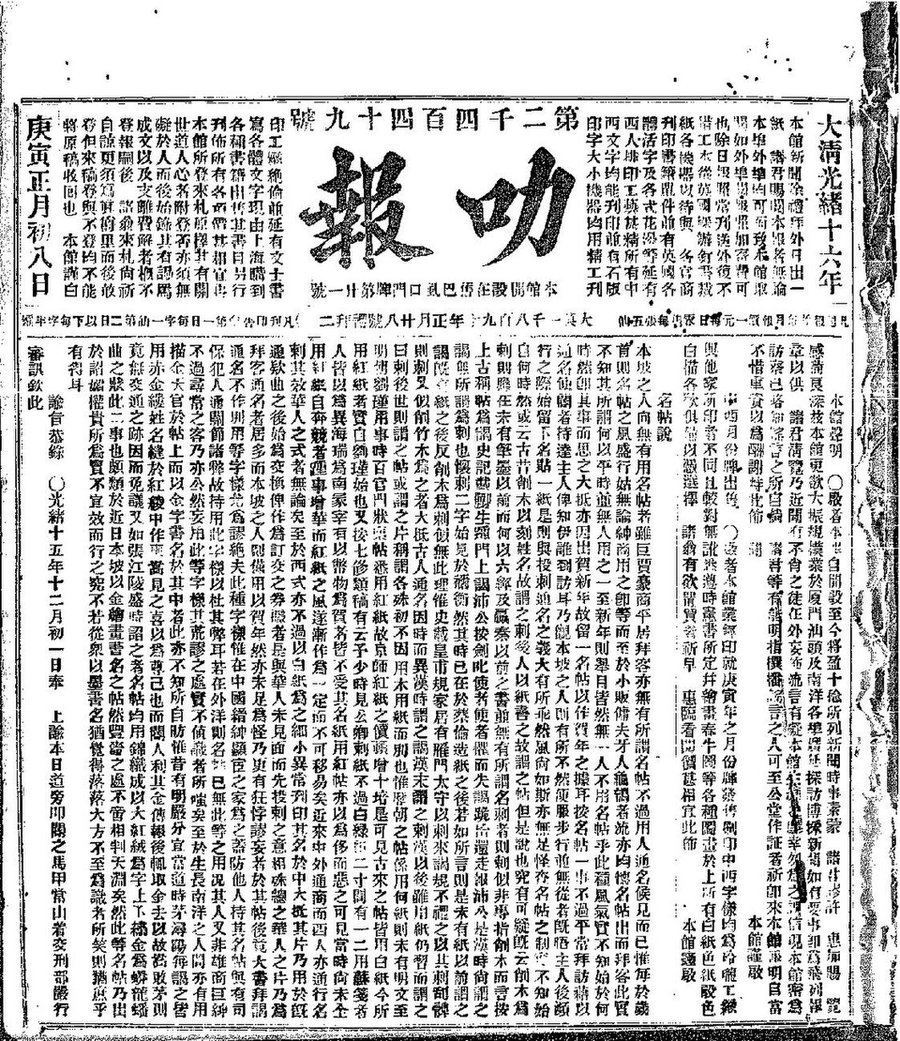 |
| 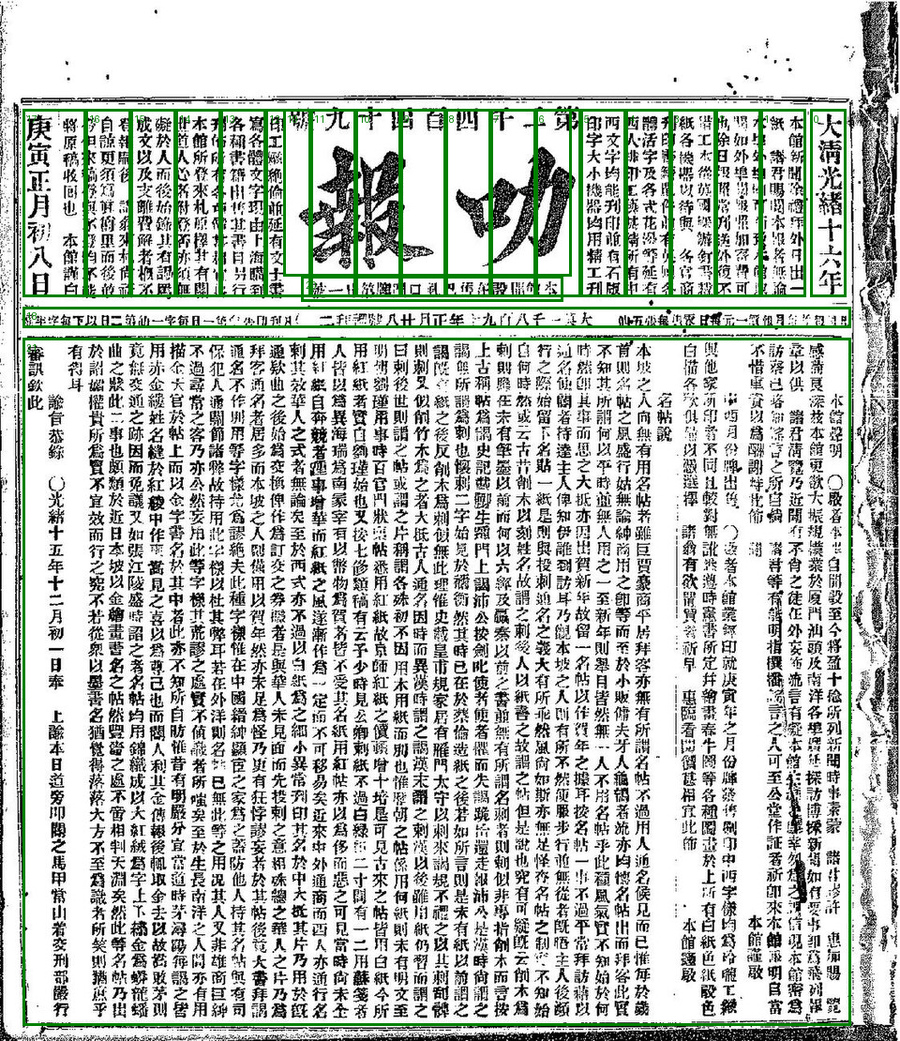 | 大清光緒十六年
本館新聞除禮拜外日出一張
諸君賜閱本報者無論本埠外埠…
工務局告示 |
| **English**
The Nation, 1846 | 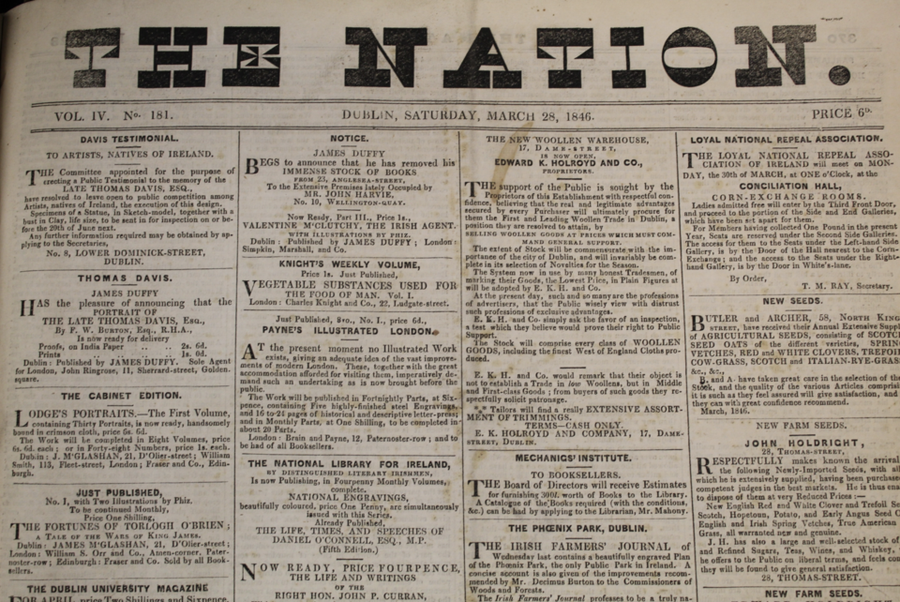 |
| 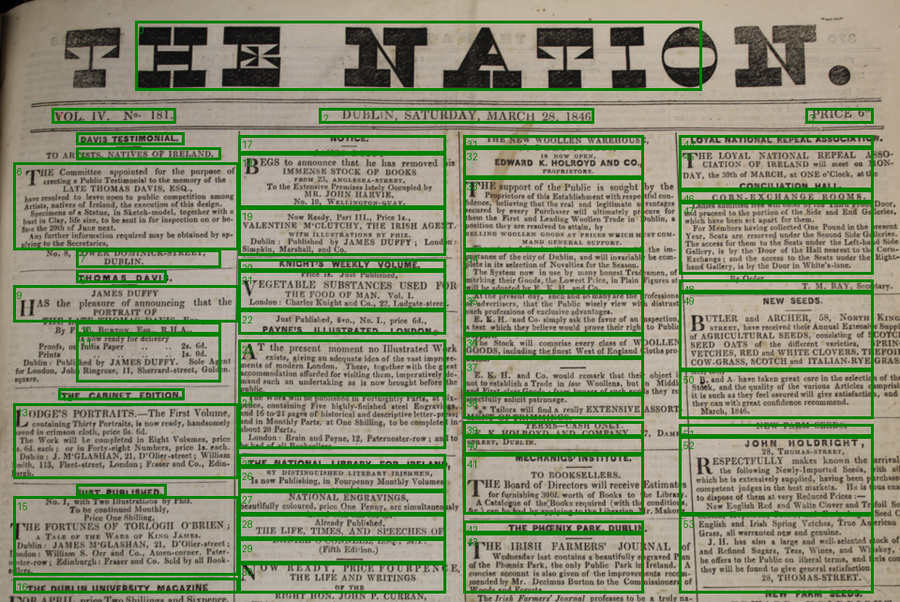 | VOL. IV. No. 181.
DUBLIN, SATURDAY, MARCH 28, 1846.
PRICE 6 D.
DAVIS TESTIMONIAL. |
| **Arabic**
Al-Ahram, 1981 |  |
| 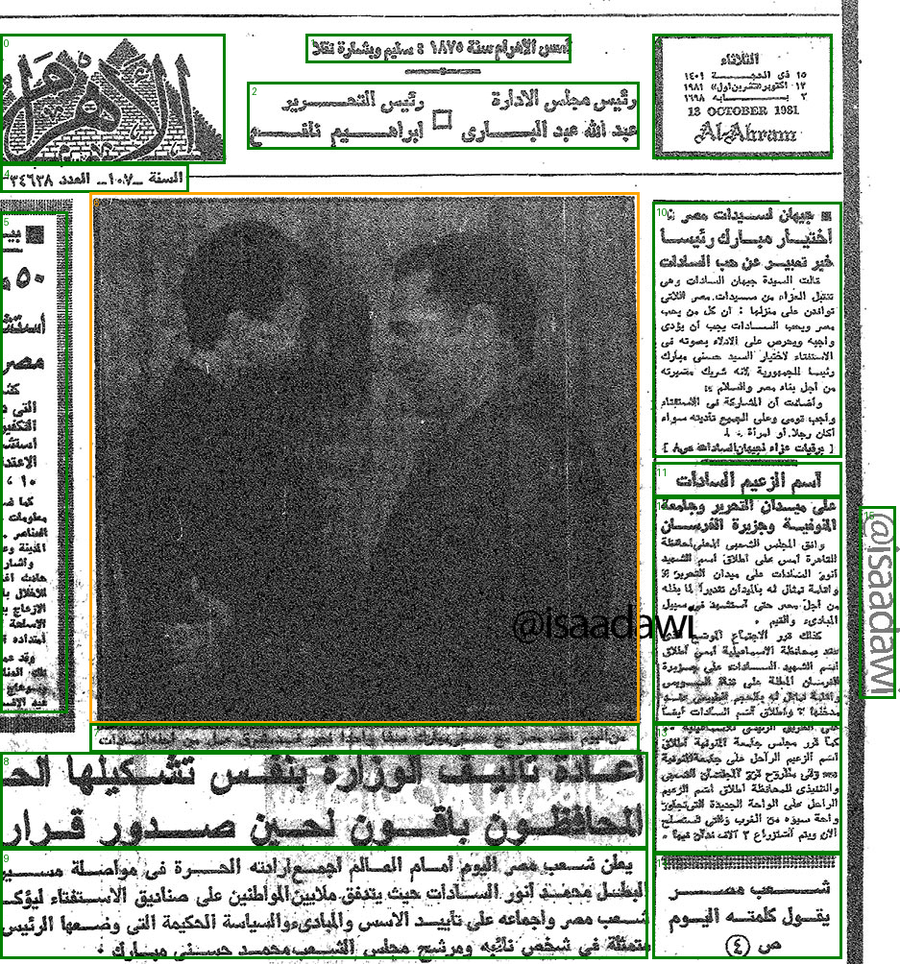 | رئيس مجلس الادارة — عبد الله عبد البخاري
المنطقات المنتصرة
السنة ١٠٠٧ — العدد ٣٩٦٣٨ |
| **Russian**
Виттова Пляска, 1905 | 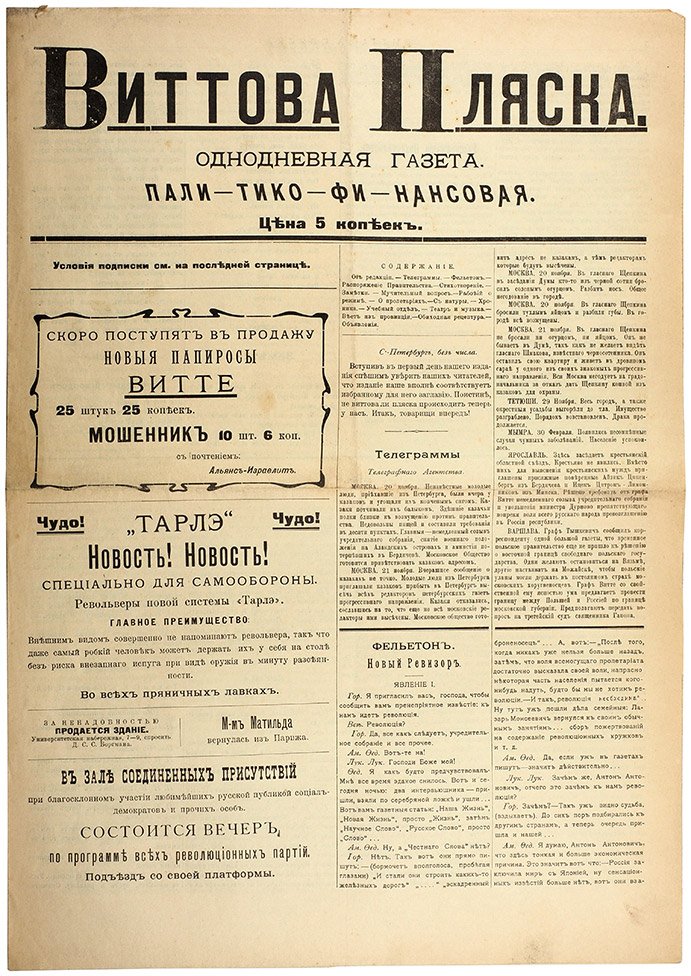 |
| 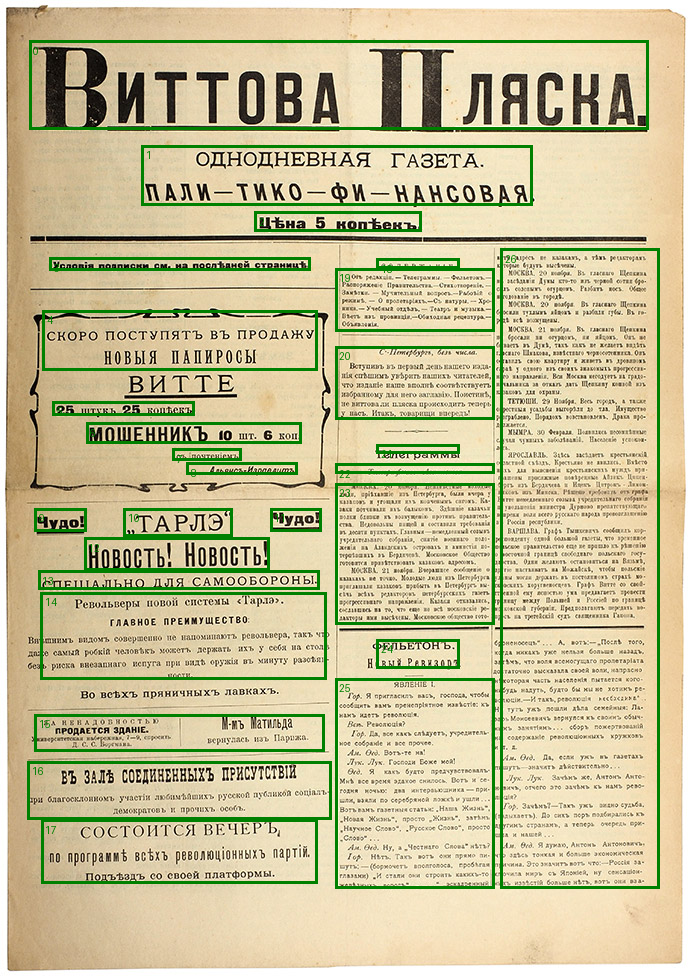 | Виттова Пляска
ОДНОДНЕВНАЯ ГАЗЕТА. ПАЛИ—ТИКО—ФИ—НАНСОВАЯ
Цѣна 5 копѣекъ. |
| **French**
Le Miroir des Sports, 1937 |  |
|  | LE MIROIR DES SPORTS
Le plus fort tirage des hebdomadaires sportifs
Mardi 10 Août 1937 |
> Excerpts are the model's **raw** output on hard, dense historical scans — ornate mastheads
> (e.g. the gothic “THE NATION”) are the failure cases. Reproduce any row with, e.g.,
> `python -m surya.scripts.ocr_text assets/russian_original.jpg`, or via the API/CLI examples below.
---
## API
FastAPI app served on port **5002**. Interactive docs: `http://:5002/v1/api/ai/swagger`.
All OCR endpoints accept the same JSON body and return the same envelope.
**Request body:**
```json
{
"file": "",
"type": "png", // one of: png | jpg | jpeg | gif
"skip_text_detection": false, // true ⇒ full-page OCR, skip layout
"skip_table_detection": false, // table endpoint only
"recognize_math": false,
"ocr_with_boxes": true
}
```
**Response envelope:**
```json
{ "data": { "ocr_text_json": {...}, "text_lines": "line1\nline2\n...", "elapsed_seconds": 4.64 },
"message": "success",
"code": 200 }
```
| Method | Path | Purpose | Backend |
| --- | --- | --- | --- |
| POST | `/v1/api/ai/suya_ocr_vllm/` | **Primary OCR** — layout + recognition, request-batched | vLLM |
| GET | `/v1/api/ai/suya_ocr_vllm/health` | Backend info (model, base URL, mode, parallelism) | — |
| POST | `/v1/api/ai/suya_ocr/` | OCR (routes to the same vLLM path) | vLLM |
| POST | `/v1/api/ai/suya_layout_det/` | Layout detection only | vLLM |
| POST | `/v1/api/ai/suya_table_rec/` | Table structure recognition | vLLM |
| POST | `/image2text` | OCR a multipart file upload (no base64) | vLLM |
> The legacy `/v1/api/ai/suya_text_det/` endpoint targets the standalone torch detection model,
> which is **not loaded** in the vLLM deployment (the VLM does detection internally). It will
> return an error envelope — use `/suya_ocr_vllm/` instead.
### OpenAI-compatible endpoint (`POST /v1/chat/completions`)
Point any OpenAI client at `http://:5002/v1`. Attach the page as an `image_url`
content part; the joined OCR text comes back in `choices[0].message.content`, and the
structured per-line JSON + timing come back in a non-standard `surya` field.
OCR options are passed through `extra_body` (the OpenAI SDK delivers these at the top
level of the request, which is where the server reads them):
| Field | Default | Purpose |
| --- | --- | --- |
| `mode` | `block` | `block` (layout→per-block), `full_page` (one call), or `table` |
| `skip_text_detection` | `false` | Full-page OCR, skip layout (same as `mode:full_page`) |
| `recognize_math` | `false` | Math-aware recognition |
| `skip_table_detection` | `false` | `mode:table` only — treat whole image as one table |
| `ocr_with_boxes` | `true` | When `false`, omit `surya.ocr_text_json` (text only) |
Streaming (`stream:true`) is **not supported** and returns HTTP 400 — OCR completes
all at once, so there is no token stream.
### OpenAI-compatible backend
Recognition and layout are issued as **OpenAI Chat Completions** calls to the vLLM server
(`POST {SURYA_INFERENCE_URL}/chat/completions`, default `http://127.0.0.1:8000/v1`), one per
image crop, with the page image passed as a base64 `image_url` content part. This means the
inference tier is a standard vLLM OpenAI server — you can point `SURYA_INFERENCE_URL` at any
OpenAI-compatible vLLM endpoint (local, remote, or a shared cluster).
---
## Concurrency support
Two cooperating layers keep the GPU saturated without overcommitting:
1. **Request batcher** (`vllm_batcher.py`): a background thread coalesces incoming page
requests that share the same options into one batch — up to `SUYA_MAX_BATCH_SIZE` (8),
waiting at most `SUYA_BATCH_WAIT_MS` (25 ms). Requests queue up to `SUYA_MAX_QUEUE_SIZE`
(128); callers block on a future until their page completes.
2. **vLLM sequence slots**: within a page, the detected blocks are fanned out over HTTP up to
`SURYA_INFERENCE_MAX_INFLIGHT` (16) concurrent workers, matching vLLM's `--max-num-seqs` (16)
so every sequence slot is filled. (Overcommitting past 16 only queues — see the diagnosis.)
**Measured behaviour** (single A100, `benchmarks/concurrency_sweep_results.csv`) — 1→50 concurrent
clients, **0 failures** at every level. Throughput is GPU-bound and plateaus around
**0.20 req/s** on one model replica:
| Concurrency | Success / Failed | Throughput (req/s) | Mean latency (s) | p95 latency (s) |
| --- | --- | --- | --- | --- |
| 1 | 1 / 0 | 0.13 | 7.66 | 7.66 |
| 4 | 4 / 0 | 0.19 | 20.95 | 20.96 |
| 8 | 8 / 0 | 0.19 | 34.05 | 41.46 |
| 12 | 12 / 0 | 0.20 | 45.55 | 59.96 |
| 20 | 20 / 0 | 0.20 | 66.68 | 92.91 |
| 30 | 30 / 0 | 0.20 | 90.50 | 147.47 |
| 50 | 50 / 0 | 0.21 | 149.29 | 240.87 |
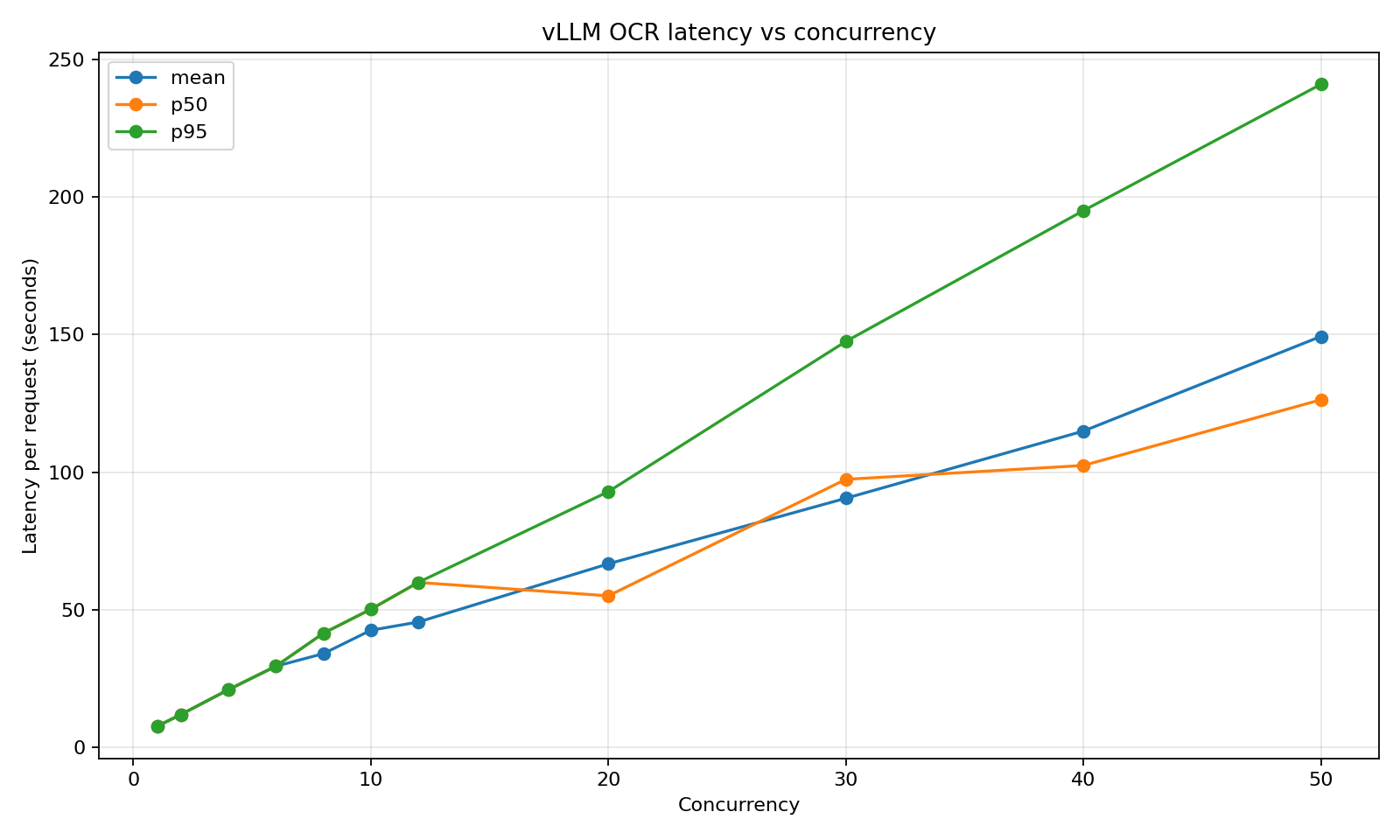
Scale throughput by adding GPU replicas behind a load balancer, each with its own vLLM server.
---
## How to use
### Run with Docker (recommended)
```bash
docker build -t suya-ocr-api .
docker run --rm --gpus all -p 5002:5002 suya-ocr-api
```
The container entrypoint (`scripts/start_single_container.sh`) starts the vLLM server with the
tuned flags, waits for it to become healthy, then launches the API on `:5002`.
> **Deployment target:** the Dockerfile defaults target **T4** (`VLLM_DTYPE=float16`,
> `VLLM_GPU_TYPE=t4`). On bf16-capable GPUs (A100/L40/4090) set `VLLM_DTYPE=bfloat16`.
### API mode — call the HTTP service (curl)
```bash
# encode an image and OCR it
B64=$(base64 -w0 page.png)
curl -s http://localhost:5002/v1/api/ai/suya_ocr_vllm/ \
-H 'Content-Type: application/json' \
-d "{\"file\":\"$B64\",\"type\":\"png\",\"ocr_with_boxes\":true}" \
| python3 -c "import sys,json; d=json.load(sys.stdin)['data']; print(d['text_lines']); print('elapsed:', d['elapsed_seconds'])"
# full-page OCR (skip layout) — good for single-column pages
curl -s http://localhost:5002/v1/api/ai/suya_ocr_vllm/ \
-H 'Content-Type: application/json' \
-d "{\"file\":\"$B64\",\"type\":\"png\",\"skip_text_detection\":true}"
# health / backend info
curl -s http://localhost:5002/v1/api/ai/suya_ocr_vllm/health
```
### Demo: OCR one image via the OpenAI API
**OpenAI Python SDK** (the headline "it's really OpenAI-compatible" path):
```python
import base64
from openai import OpenAI
client = OpenAI(base_url="http://localhost:5002/v1", api_key="not-needed")
with open("page.png", "rb") as f:
b64 = base64.b64encode(f.read()).decode()
resp = client.chat.completions.create(
model="surya-ocr",
messages=[{
"role": "user",
"content": [
{"type": "image_url", "image_url": {"url": f"data:image/png;base64,{b64}"}},
{"type": "text", "text": "Extract the text"},
],
}],
extra_body={"mode": "block", "ocr_with_boxes": True},
)
print(resp.choices[0].message.content) # plain OCR text
print(resp.model_dump()["surya"]["ocr_text_json"]) # structured boxes
```
**curl** (data-URL base64 image):
```bash
B64=$(base64 -w0 page.png)
curl -s http://localhost:5002/v1/chat/completions \
-H 'Content-Type: application/json' \
-d "{\"model\":\"surya-ocr\",\"messages\":[{\"role\":\"user\",\"content\":[{\"type\":\"image_url\",\"image_url\":{\"url\":\"data:image/png;base64,$B64\"}},{\"type\":\"text\",\"text\":\"ocr\"}]}]}" \
| python3 -c "import sys,json; print(json.load(sys.stdin)['choices'][0]['message']['content'])"
```
### CLI mode — local OCR (no HTTP server)
Run OCR straight from the command line. The `surya` package spins up its own vLLM-backed
inference backend, so the FastAPI server does **not** need to be running. Input can be a single
image, a PDF, or a folder of them; results are written as `results.json`.
```bash
# OCR an image or PDF → writes results/surya//results.json
python -m surya.scripts.ocr_text page.png
# pick an output dir and OCR only some PDF pages (0-indexed; ranges allowed)
python -m surya.scripts.ocr_text doc.pdf --output_dir out --page_range 0,2-4
# also save annotated bbox images, and print per-stage timing
python -m surya.scripts.ocr_text page.png --images --debug
```
By default the CLI **autostarts a vLLM server** (`SURYA_INFERENCE_AUTOSTART=true`) and tears it
down on exit. To reuse a vLLM server that is already running (for example the one started by the
Docker container or `scripts/start_single_container.sh`), point the CLI at it instead of spawning
a new one:
```bash
SURYA_INFERENCE_URL=http://127.0.0.1:8000/v1 python -m surya.scripts.ocr_text page.png
```
Pass `--keep_server` to leave a spawned server up so back-to-back commands reuse it. Sibling
commands share the same options (run with `--help`):
`surya.scripts.detect_layout`, `surya.scripts.detect_text`, `surya.scripts.table_recognition`.
### Run without Docker
Requires a CUDA GPU with the matching vLLM. Start the two processes (vLLM first, then the API)
exactly as `scripts/start_single_container.sh` does, or run that script directly inside an
environment that already has the dependencies from `requirements.txt`.
---
## Configuration
Set via environment variables (defaults shown; see `Dockerfile` and `surya/settings.py`):
| Variable | Default | Purpose |
| --- | --- | --- |
| `SURYA_INFERENCE_URL` | `http://127.0.0.1:8000/v1` | vLLM OpenAI endpoint |
| `SURYA_INFERENCE_PARALLEL` | `8` | Recognition worker hint |
| `SURYA_INFERENCE_MAX_INFLIGHT` | `16` | Max concurrent HTTP calls to vLLM — **keep = `VLLM_MAX_NUM_SEQS`** |
| `SUYA_OCR_MODE` | `block` | `block` (layout→per-block) or `full_page` (single call) |
| `SUYA_MAX_BATCH_SIZE` | `8` | Request-batcher coalesce size |
| `SUYA_BATCH_WAIT_MS` | `25` | Request-batcher wait window |
| `SUYA_MAX_QUEUE_SIZE` | `128` | Request-batcher backlog cap |
| `VLLM_DTYPE` | `float16` | `bfloat16` on A100/L40/4090; `float16` on T4 |
| `VLLM_MAX_MODEL_LEN` | `18000` | vLLM context length |
| `VLLM_MAX_NUM_SEQS` | `16` | vLLM sequence slots |
| `VLLM_GPU_MEMORY_UTILIZATION` | `0.85` | vLLM GPU memory fraction |
---
## Benchmarks
- `benchmarks/` — concurrency sweep scripts and results (see the table above)
- `scripts/quant/` — the quantization benchmarking toolchain (build, serve, capture, score, plot)
---
## Acknowledgements
This project is a serving wrapper around **[Surya OCR](https://github.com/datalab-to/surya)** by
**[Datalab](https://www.datalab.to/)**. All layout detection and text recognition is done by their
[`datalab-to/surya-ocr-2`](https://huggingface.co/datalab-to/surya-ocr-2) model — this repo only
adds the vLLM serving, request batching, and API/CLI around it. Huge thanks to the Surya team for
building and open-sourcing such a capable multilingual OCR model.
- Official site:
- Surya GitHub:
- Model: